

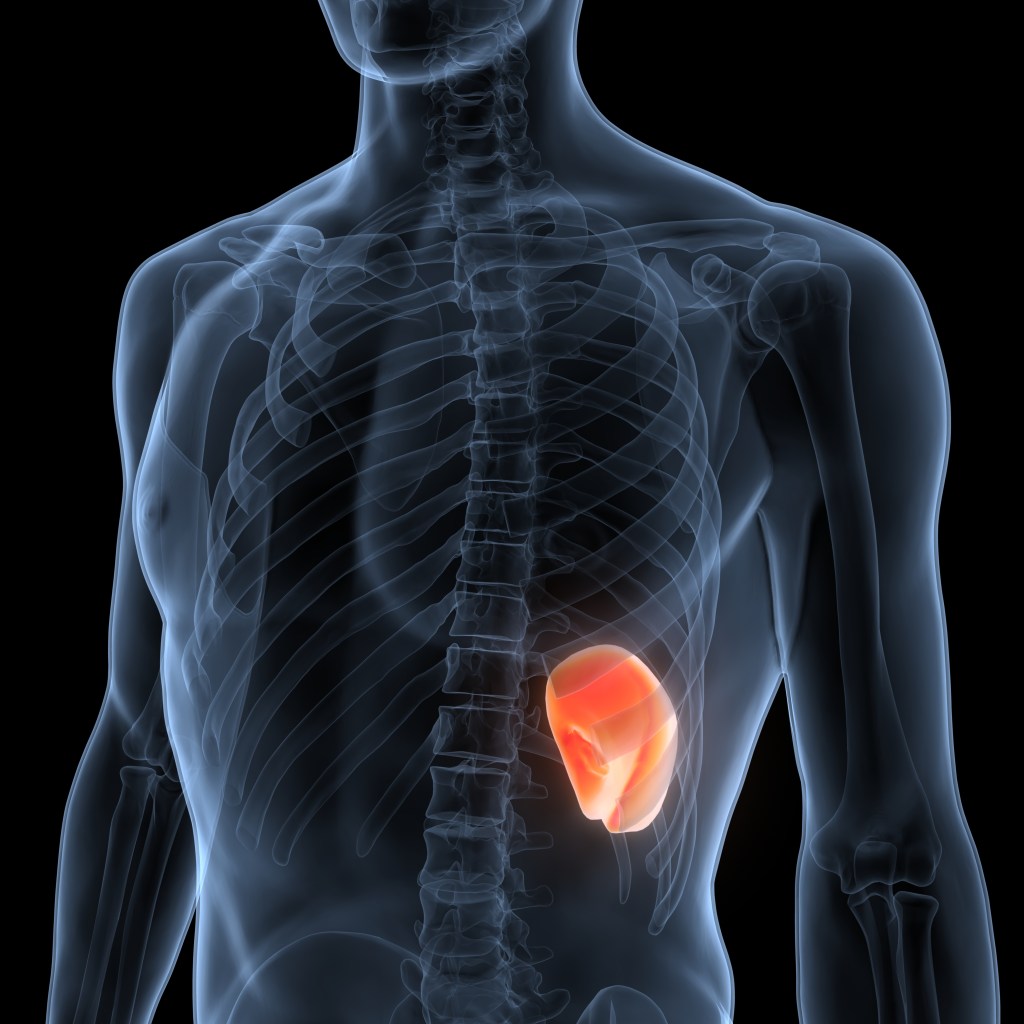
R and I went to see a nurse practitioner at Fred Hutchinson Cancer Center in Seattle yesterday to discuss his newest symptoms: major leg and foot cramps, mostly at night (it’s horrible to watch him go through these) and rapid weight gain.
You may recall that he’d unintentionally lost twenty-five pounds before the diagnosis–a result of his massive spleen crowding his stomach. So, you ask, why worry about weight gain? It could be a sign of continued spleen growth, meaning cancer progression. Plus, if it gets large enough, it can rupture, causing deadly internal bleeding.
The nurse manually palpated R’s spleen (rather than check it with an ultrasound), and it’s roughly the same size as in September. On the one hand, it’s good that it’s not growing. On the other-other hand, it could mean that his new medication, Jakafi (generic name Ruxolitinib), will not be effective for him. After some conversation, the medical team decided to leave R on the Jakafi to give it more time to do its job. So… it’s a wait-and-see situation.
Some people have asked why R doesn’t just have his spleen removed. Answer: a person can live without a spleen, but patients with Myelofibrosis have a greater incidence of mortality during and after surgery (reduced ability to fight infection).
As far as the cramping R is experiencing–it’s a common side effect of the Jakafi–a necessary evil at this point. R now eats pickles before bed, which can help reduce cramps. There are lots of home remedies out there. He’s tried eating a spoonful of yellow mustard when the cramps start, rubbing on some over-the-counter foamy stuff before bedtime, taking potassium pills and more.
Regarding R’s blood work, many of his numbers are dropping farther outside the normal ranges, including white blood cell count, red blood cell count, hematocrit and hemoglobin levels. His red cell distribution width (RDC-CV) is too high (meaning too many irregularly shaped red blood cells), but his platelets are normal. The medical team is most concerned about the anemia resulting from the low red blood cells. They will work to get R approved for a trial medication that could address the anemia. More wait and see.
I am creating a spreadsheet to track the disease indicators to see trends over time. Knowledge is power! That’s it for now. It’s been a while since I’ve posted here, but there hasn’t been much to say until now. Happy holidays all!
 Myelofibrosis--A Personal Journey